
Creator Spotlight with Author James Edwards
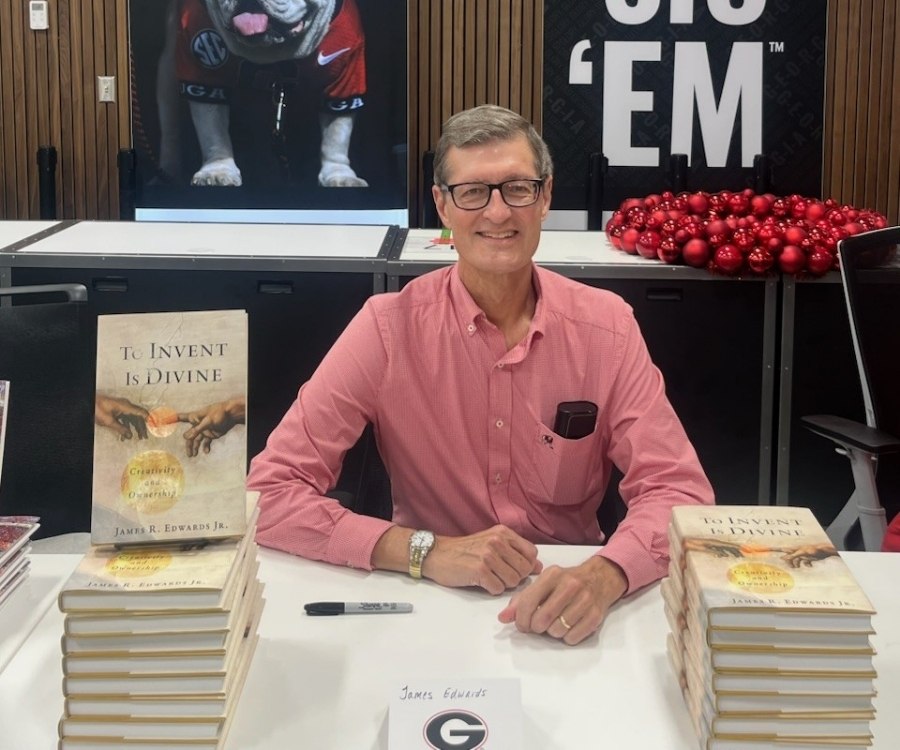
This week, we’re pleased to introduce you to author James Edwards. He is the author of the insightful book To Invent is Divine: Creativity and Ownership, and is the Founder and Executive Director of Conservatives for Property Rights.
What was the inspiration behind becoming a creator? What do you enjoy most about the creative process?
My mother inspired and encouraged my creativity. She was creative herself, such as enjoying oil painting, pen and ink drawing, playing piano, and painting ceramics. My mother got behind the various pursuits that captured my attention at different stages: drawing, painting, piano, guitar, choral music, voice lessons. My second-grade teacher told my mother that I showed creativity in writing and pictures I’d draw. Mama had the indiscretion to tell me what my teacher had said. That recognition planted a seed because it came from an adult who wasn’t a relative. Also, American history and politics were interests from early on.
I had the impression my teacher had in mind that I might excel at fiction writing. As it turned out, I was drawn to writing nonfiction. This was validated along the way, such as in co-winning a national editorial writing contest. Writing has been central in the jobs I’ve had over the past 35 years. I’ve primarily used creativity in writing while working on Capitol Hill as a press secretary and legislative aide, at the Republican National Committee as speechwriter, as a trade association executive in the communications shop and pitching in on legislative projects, and for the past 25 years as a public policy and advocacy consultant at two firms and eventually as an independent consultant.
What I enjoy most about the creative process, whether I’m writing an op-ed, talking points, a speech, or a policy white paper, is turning my research findings into a clear, accurate, (hopefully) engaging work product. It’s the crafting, the composition, and the wordsmithing that I enjoy the most.
When did you first become aware of copyright, and why?
My first encounter with copyright occurred around fourth grade. Some books that I read about the American Revolution and the Founding covered the Declaration of Independence and the U.S. Constitution, in addition to the war. I learned that in the Constitution, the Founders gave Congress specific authorities, including to enact copyright and patent laws. In graduate school, I took a communication law class that taught copyright. It sparked my interest as it covered concepts such as fair use and work-made-for-hire. The idea of protecting someone’s creative works as private property resonated with me—also, that these exclusive rights to one’s creative works appear in the Constitution itself, rather than being added later in the Bill of Rights.
What is To Invent Is Divine about? What led you to write this book?
To Invent Is Divine: Creativity and Ownership (Fidelis, 2025) explores how humans are endowed with the divine attributes of creativity and ownership. It discusses how this combination leads to human flourishing. When humans can use our creative abilities while securely owning the fruits of our creative labors, the potential and incentives exist for creativity and innovation to improve the human condition, both at the individual and societal level. To Invent Is Divine delves into Judeo-Christian teachings on divine and human creativity and inherent ownership, and how America’s intellectual property system uniquely applies that divine creativity-ownership model. The discussion moves from colonial subjugation by Britain to James Madison’s proposing intellectual property protection in what became Article I, Section 8, Clause 8 of the U.S. Constitution, to the United States’ rapidly becoming the most creative, inventive nation on the globe. The focus turns to the weakening of the United States’ framework of human creativity and property rights, and explores how that model for fostering human thriving can be strengthened.
The idea of turning a well-received speech into a book was suggested by a good friend after I told him of the audience’s positive reception. There were 75 or more people in attendance, nobody left early, and robust discussion ensued. The speaking invitation came months earlier, when I had informed a state director for a public policy organization why patent policy is one of its priorities. She asked me to speak at a class at her church, specifically to discuss patents and invention from a biblical perspective.
Can you talk through your creative process? How long does it take? Does everything you produce make money?
Upon getting a writing assignment or conceiving of something I want to write, I think about the subject, the purpose, the audience, and the parameters—e.g., 700-800 words for an op-ed, 1,000-1,500 words for a policy white paper. I jot down key items and ideas I want to include, and consider options for an interest-catching opening. Then I start drafting, putting words on screen. For longer projects, such as a report, a monograph, or a book, the process is more formal—an outline, more fully developed descriptions, etc. Projects take as long as necessary to produce a polished draft, especially so on client projects. The shorter project formats typically take a few hours, which include research on the fly as I look for a fact or figure that substantiates a certain point or something I recall that would make a compelling item to hyperlink for readers’ convenience. Writing my book To Invent Is Divine, the process followed the same, longer-project approach, only it was like writing a series of papers that required even greater attention to continuity among all the various subjects covered in the chapters.
After leaving congressional staff work, I coauthored a book, The Congressional Politics of Immigration Reform, with University of Maryland political scientist James Gimpel. I had staffed a lawmaker who served on the House Judiciary Committee, which was crafting major legislation that became law. I had handled the staff work that gave me a front-row seat to the legislative process. My contribution to the book was predominately writing the story of that legislation. A book I’d read a decade earlier, Showdown at Gucci Gulch by two Wall Street Journal reporters, chronicled the fraught legislative path to enactment of the 1986 tax reform law. That was my model; if tax policy could be made interesting, then immigration policy stood a chance.
Now, most of my work-related writing projects are works made for hire, some appearing under my name in the byline, others under a client’s name. I’m compensated in my retainer, or in earlier jobs, my paycheck. In the 1990s and 2000s, I did a fair amount of freelance writing, getting paid per published article or other item. It never approached being remunerative enough to make a living. More recently, there’s an occasional stipend or payment for a particular deliverable. The Congressional Politics of Immigration Reform brought in some modest royalties for a few years. I’ve also contributed chapters or entries to edited volumes, but all they’ve yielded were bylines, author credits, and a copy of the final product. I’ve also written a number of poems and songs over the years, but none that I’ve tried to commercialize—yet.
What do you think is the biggest misconception about your line of work?
My consulting involves lobbying as one part of my job, though I’m essentially a professional communicator. Yes, it does involve communicating with lawmakers or officials and their staff members in the U.S. Senate and House and federal agencies. I can get pigeonholed. For many, lobbying conjures up images of smoke-filled rooms and worse. However, my work involves communicating with large audiences, applying several skill sets and knowledge of intellectual property and other policy issue areas. My typical creative works span a range of written communication forms, such as developing a one-page fact sheet, writing talking points, drafting a blog post or op-ed, writing public comments or correspondence on legislative or regulatory matters, and putting together a program and run of show for events like a panel discussion.
What is the best piece of advice that you would give other creators in your field about copyright and how to protect themselves?
If possible, include in your contracts language specifying that anything you create that isn’t designated ahead of time by consent as work-made-for-hire belongs to you, with all rights reserved. This is helpful if you work on the same or similar subject matter for more than one party. There are some clients for whom I provide the contractual language, in which my agreements contain the above provision. There are those clients who present a buttoned-down contract with no room for negotiation and that define work-made-for-hire broadly. Either way, be clear about the terms to which you’re agreeing. Don’t hesitate to consult an intellectual property attorney who has knowledge and experience with copyright law. Better to know your options on the front end and choose wisely than suffer loss and heartache later.
If you aren’t already a member of the Copyright Alliance, you can join today by completing our Individual Creator Members membership form! Members gain access to monthly newsletters, educational webinars, and so much more — all for free!