
Creator Spotlight with Actor and Creative Writer Beks Roen
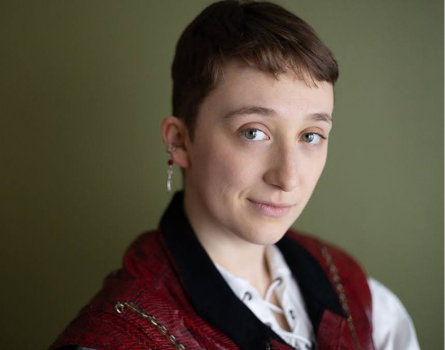
This week, we are pleased to introduce actor, producer, and creative writer, Beks Roen (they/he). They dedicate their livelihood to helping “trans/aspec folks and allies find chosen family through queer fantasy and Shakespeare.” Beks has six years of professional acting experience and over 14 international publications. Additionally, he has been involved in three world premieres (“On The Cusp,” Hudson Valley Shakespeare; Boy-ish, So Deck the Halls, Blanket Fort Theatre). After reading Beks’ Creator Spotlight blog, check them out on Instagram.
What was the inspiration behind becoming a creator? What do you enjoy most about the creative process?
At first, I accidented my way into professional Shakespeare by going to an audition to learn what an audition was. Then I went to college for theatre engineering, which lasted 1.5 semesters (thanks COVID), after which I switched to acting and creative writing. I got to start my producing in earnest here (thanks Purdue undergrad workshops!), published several pieces of poetry, and got support to train in stage combat (thanks Purdue CLA & Joel Ebarb!). Each artistic adventure opened new ways to connect with others and grow together. I remember the look on one of my stage combat students’ faces when a rapier technique clicked: suddenly, one of the shyest people I knew was standing tall and confident for the first time in my memory. How beautiful is that?
I started my production company Roguish Goblin Stories because I realized I was paying myself and my artists way better than most of the traveling theatre gigs I was taking (like, $2/hour or even less out of state versus $20/hour on my own). The nonprofit sector is…difficult right now, so knowing how much a lot of those theatres are working just to pay artists anything… my heart goes out to ya. Hang in there. And the arts in general aren’t valued as much as they deserve in our culture, so yeah, funding can be tricky. And I’ve seen some incredible generosity from Midwestern Christians who raised enough to pay a majority-queer team over $20/hour to do a D&D-inspired play in a church for free. It can happen. And it has, for me, repeatedly.
I saw how much my free live theatre shows meant to my community, and how much getting paid $20+/hour meant to the artists I worked with (some had never been paid for their art before). People coming up to me saying, “Because I see you, I know I’m gonna be okay,” “Your show gave my kid a chance to practice being okay with saying ‘I don’t know,’” “You’re the first person like me I’ve seen,” “I can’t believe someone like me would be welcome here.” And on and on.
So I started Roguish Goblin Stories to share our productions digitally, a la StarKid or National Theatre. I’m sharing behind-the-scenes to encourage more artists (whether they call themselves artist yet or not) to make their own things. And everything centers around this truth: you’re loved and you’re not alone. RGS focuses on trans and aspec (asexual and aromantic) stories, since those are nigh invisible in the entertainment sector right now (and it’s my lived experience, so it’s gonna come through whether I “mean to” or not).
My favorite part of the creative process is the learning. Every time I sit down to write, pick up a sword, or learn a new scene, something surprises me. Goosebumps take over. I feel the energy of the world shift, opening up like flowers around myself and the group. It’s as much a spiritual practice for me as it is a creative one. And the healing I see happen, especially in theatre spaces, is a joy like nothing else I’ve witnessed.
Can you talk through your creative process? How long does it take? Does everything you produce make money?
As a multihyphenate, I have a few processes depending on what project is at the forefront, but I have some daily habits that support me regardless. These include a morning workout with ETF tapping and meditation to set my nervous system up for success, writing in my next novel, and (on weekdays) making 1-3 connections to share audiences with other creatives, activist groups, and business owners.
I set aside one day per week that’s creative focused, where I move the needle on scripts, poetry, and novels. My writing process is far more relaxed than it used to be; instead of a granular outline for each beat, it’s become a broader constellation of images, characters, and events I feel drawn to or curious about. When I sit down to write, I don’t feel like I’m “creating” anything. Rather, I’m sitting in the house of a theatre, watching the story play out onstage, and like the scribes of Elizabethan-era theatre, I’m just trying to keep up and record everything I witness.
My production process has more logistics: space, rehearsal schedule, casting/hiring, setting budgets, finding necessary tech (I keep this to a minimum to allow the audience the chance to focus on the actors & story), marketing, etc. This is the one that always surprises me; I only recently began to call myself a producer (even though my first production was before my first professional actor gig), but I genuinely have so much fun producing. I get to host a space for fellow artists to be paid incredibly well for their art, where audiences get to see theatre for free, and where we center queer stories in unexpected places! Like, what a dream. I can’t imagine doing anything else. And yes, sometimes I’m also onstage, or fight directing, or both. I love all of it.
When I get a full hour of writing every day, I can write an entire novella in 30 days. I don’t blame myself if that doesn’t happen, because I’d rather have a rhythm than a strict regimen that has no room for me to support my family when something unexpected arises. Productions can take 3-8 weeks, depending on how much rehearsal the show needs and how many performances we set. I prefer to have shorter rehearsals over more weeks so my artists aren’t exhausted by the prep, but sometimes logistics are such that we have to crunch. The thing I love about theatre people is that we’re really good at rolling with whatever we’ve got. And making absolute magic in the process.
Does everything I produce make money? Not yet, though I’m working on it. RGS started August 1, 2025, so we’re welcoming subscribers and VIPs to fund our first full shows! beksroen.org/rgs
What do you think is the biggest misconception about your line of work?
A lot of it circles around rigid ideas of who’s “legit.” Eg, performing outside hub cities like NYC & LA make you part of “flyover country,” which “doesn’t count.” Or, Shakespeare and fantasy aren’t open to aspec (asexual and/or aromantic) and trans folks.
In Shakespeare, I see more invisibility around the aspec communities. Shakespeare has this reputation for being bawdy, and creating the “greatest love story” with Romeo & Juliet (even though he’s mostly poking fun at Petrarchan lover archetypes and interrogating what happens when love gets corrupted into extremes of hate and infatuation). But as I’ve continued to dig into the texts, even Romeo reads incredibly through an aspec lens. Part of why I started Roguish Goblin Stories is to highlight the work of aspec scholars like Dr. Liza Blake, Dr. Aley O’Mara, Dr. Cat Clifford, Liesl Jensen, and others, and translate their dramaturgies onto the stage.
Fantasy tends to cast trans and aspec folks as non-humans, if we even get any representation. I’m seeing more aspec rep in fiction, but the performing arts have yet to catch up (which is why I started Roguish Goblin Stories!).
As far as the whole “flyover country” myth, I couldn’t disagree more. I’ve found incredible allies and queer folks doing the best theatre I’ve ever seen in tiny little pop-up theatres around rural communities across the Midwest. That scrappy, outdoor theatre is my favorite. It opens the best possibilities for truly connecting with the audience. When you don’t have a ton of tech, the audience is focused on the story and the performers. I see artists rise to higher levels of excellence in these spaces, and you get swept up in just how much they love their art.
When did you first become aware of copyright, and why?
I was a creative writing student in undergrad, and it came up in some of my later classes as the professors opened time for questions on publishing. I immediately went to the U.S. Copyright Office and registered my first batch of plays, which gave me the confidence to really lean into producing.
What is your biggest copyright-related challenge?
My biggest copyright-related challenge is timing — when to register a work in relation to publishing, especially self-publishing in the case of zines, and budget (because I have the policy, “don’t spend what you don’t have.”).
How has AI technology impacted your works and career?
As a theatre maker and writer who recently got into zines, I’m seeing people already gravitate back towards my fields because they’re human. People are returning to physical media, preferring to be able to hold and own the art. We’re craving in-person connection, and theatre is the most powerful place (in my experience) to gather with strangers and go on an emotional journey together that opens the chance for deep connection. As Sir Ian McKellen put it on Colbert, “There we are, we’re in the same space, and something happens, there’s a collective happening…and at the end of the evening, you can turn to a total stranger next to you and say, ‘Well, what did you think of the show?’ And if it’s worked, you never forget it.” And like Sir Ian, I want to be a part of that for as long as I can.
So I see AI as a very visible spark that woke a lot of us up to just how much we really want from art: that human connection, the ability to watch an artist grow and learn over a body of work (thanks Brandon Sanderson for working that one out in a recent keynote), that magical moment when an actor makes eye contact with an audience member, and they join each other on an adventure that helps us feel loved and held. My activist side loves seeing the environmentally responsible niche AIs that are preserving indigenous languages, and I’m excited to be a part of the coming renaissance where we return to human connection, human art, and remember how to live life well together.
If you aren’t already a member of the Copyright Alliance, you can join today by completing our Individual Creator Members membership form! Members gain access to monthly newsletters, educational webinars, and so much more — all for free!