

AI Developers’ Trail of Book Destruction
The Copyright Alliance has long supported the responsible, ethical, and respectful development and use of artificial intelligence (AI). However, we raise a ruckus on behalf of the copyright community when we think the “responsible, ethical, and respectful” benchmarks are being subverted by AI developers. We have written profusely about one of those instances—the ingestion of copyrighted works for training without compensating creators. But lately there has been much written by reputable news organizations about a new wrinkle to that training activity that is especially troubling and, in our view and just about everyone else’s,[1] fails the “responsible, ethical and respectful” standard appallingly. [2]
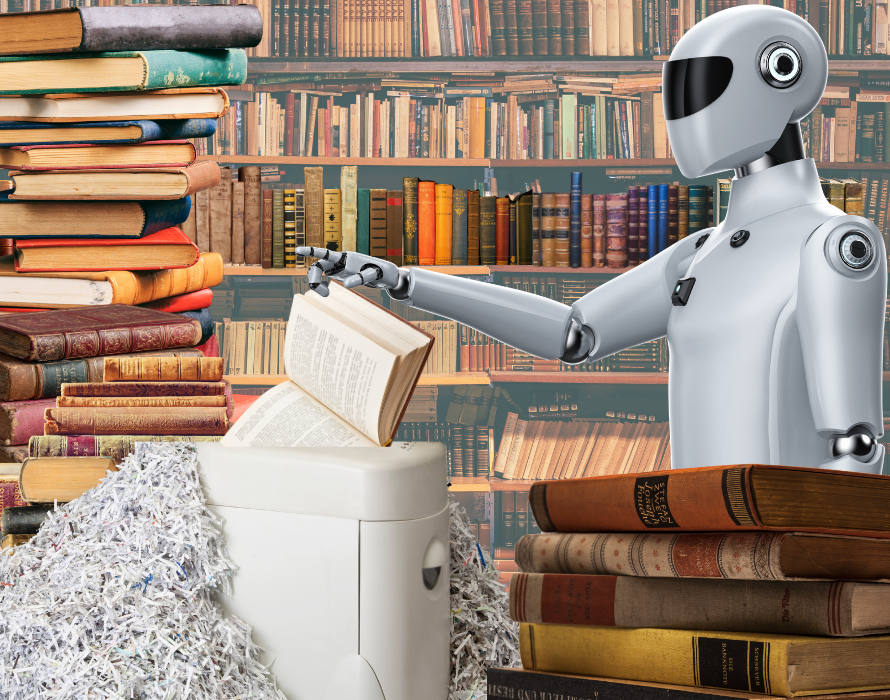
We have recently learned that, in addition to scraping pirated works from illicit websites and breaking through firewalls to obtain copyrighted works to train on, AI developers are now also buying up billions of books throughout the world and scanning them so they can be digitized and used to train their AI models. In the process of scanning the books, they are destroying them by ripping pages from their covers using a hydraulic-powered cutting machine and then shredding or pulping what is left of the original books.
The books do not need to be destroyed for scanners to read them; there are scanning machines available that can scan books without destroying them. But as we’ve seen in other areas, AI developers seem not to care a lick about human creativity and responsible AI development and when given the choice will opt for the simplest, quickest route, regardless of who gets harmed in the process. It all falls in line with their “move fast and break things” motto.
This practice should not come as a huge surprise since this activity was first disclosed during the Bartz v. Anthropic litigation, which was decided over a year ago (more on this below). But what we have learned recently is that, since the judge in the Bartz case held this practice qualified as a fair use, many other AI developers are now modeling Anthropic’s depraved actions, resulting in a form of government-approved, AI-sponsored bibliocide. And, as if the mass destruction of books—any books—wasn’t bad enough, we recently learned that the books being destroyed include rare, out-of-print, and obscure books.
AI companies and others may defend their actions by saying that they are legally allowed to digitize the books under copyright law’s fair use doctrine as long as they destroy them, and that they are allowed to destroy the books under the copyright law’s first sale doctrine. Since our focus is on copyright law here at the Copyright Alliance, we thought we’d take a look under the hood at the AI developers’ arguments to see if they have a leg to stand on. They don’t. Here’s why….
First Sale Doctrine
The first sale doctrine is found in Section 109 of the Copyright Act. It is an exception to a copyright owner’s exclusive rights to control the distribution and display of a copyrighted work, which provides that the owner of a lawfully obtained copy of a copyrighted movie, book, record album, work of art or other copyrighted work, may sell, loan, gift, display or otherwise dispose of that particular copy of that work.
The first sale exception is what allows consumers to give books or record albums they own to a friend, throw them in the garbage, or even sell them as rare copies for more than their original value.[3] So, unfortunately, yes, the first sale exception in copyright law allows AI developers who lawfully purchased books to destroy them. But it does not require them to. And more importantly, it does not allow them to digitize them.
The first sale exception only applies to the copyright owner’s distribution and display rights. It does not apply to the reproduction right. When an AI developer (or anyone) digitizes a physical copy of a book, they are making an unauthorized copy, which violates the copyright owner’s reproduction right. An AI developer’s reckless destruction of books does not mask the reproduction that occurs during digitization, and the first sale doctrine is clear that this is not permitted.
Fair Use Doctrine
The fair use doctrine is an affirmative defense that can be raised in response to claims by a copyright owner that a person is infringing a copyright. There are no bright-line rules in determining fair use since it is determined on a case-by-case basis. Section 107 of the Copyright Act sets out four factors that must be considered in deciding whether a use constitutes a fair use. These factors are:
- The purpose and character of the use, including whether such use is of a commercial nature or is for non-profit educational purposes;
- The nature of the copyrighted work;
- The amount and substantiality of the portion used in relation to the copyrighted work as a whole; and
- The effect of the use upon the potential market for or value of the copyrighted work.
Although one factor or another may weigh more heavily in a fair use determination, each of the factors must be considered and no one factor alone can determine whether the use falls within the fair use exception. However, in practice, the fourth factor tends to be the most influential. In addition to the four statutory factors, a court may also consider other factors, such as the public interests and the goals of copyright.
As noted above, the rampant destruction of books by AI developers stems from an incorrect holding by Judge Alsup in Bartz v. Anthropic, where he opined that, under the facts in that case, buying, scanning, digitizing, and destroying books is a fair use. More specifically, he concluded that scanning the books and destroying them, was not a copyright violation because the digital version “replaced” the physical one. This one incorrect analysis—an outlier in fair use case law—seems to be what has led many other AI developers to engage in the mass destruction of books.
There is no doubt that Judge Alsup’s decision is incorrect and inconsistent with long-standing law in both the Ninth and Second Circuit. In the Ninth Circuit, various cases, like Disney v. VidAngel, A&M Records v Napster, and UMG Recordings v MP3.com, while factually different, all rejected the notion that it is a fair use to make a copy of a copyrighted work in a different format for the purposes of making it easier to access the copy.
Similarly, in the Second Circuit, Capitol Records v. ReDigi also makes clear that replacing a copy and destroying the original copy is not fair use. Perhaps the case most directly on point factually is Hachette v Internet Archive, in which the Internet Archive purchased books, scanned them, stored the original copies, and made the digitized copies available to implement their so-called controlled digital lending system. There, the court was very clear that neither statute nor case law supported Internet Archive’s fair use defense. All these cases clearly demonstrated Judge Alsup’s flawed reasoning and his ignoring of contrary precedents. Further, it is essential to note that this fragment of an opinion lurks among 130+ cases addressing AI training, and by the time it is eventually overturned, the wanton destruction of books by AI developers will have been done.
Beyond the Four Factors
Let’s go a step further and talk about why a process that involves the destruction of books, or any other copyrighted works, should not be a fair use. In addition to the four fair use factors, courts often consider both the public interest and the goals of copyright when weighing a fair use defense. The public repudiation of industrial-scale book destruction would suggest that the public interest and the goals of copyright should weigh heavily against fair use for the developer.
The ultimate goal of copyright law is to incentivize the creation and distribution of expressive works for the purpose of fostering a more enlightened society. Although it is true that physical books do not last forever, nor do all have enduring value, the reports that rare and unique copies are included in this literary extermination offend the purpose of copyright when the ultimate goal is to make the endangered into the extinct.
Historians and researchers will lose access to original sources, which is especially concerning as we confront the problem of AI-generated hallucinations. Singular, minority, and specialized voices who were published in what are now rare and out-of-print books may be silenced forever. This isn’t just a copyright issue, it’s a free speech, social justice, and cultural heritage issue. Valuable works of literary history could disappear overnight due to AI developers’ bull-in-a-china-shop approach.
To be clear, there have been previous fair use decisions in which a court found that digitizing works was a fair use. Authors Guild v. Google and Authors Guild v HathiTrust are two cases that immediately come to mind. But in these cases, the physical books were returned, and the copies were not made available to the general public. Neither Google nor HathiTrust destroyed the physical books. Destruction of books for no reason other than to make AI training easier and quicker, is exactly the type of irresponsible, unethical, disrespectful activity that strikes fear in the hearts and minds of the public about the development of AI.
It is clear that Big AI will go to any extreme in the race for market dominance—sourcing works from criminal enterprises, shrugging off the rights and sentiments of every creator who has involuntarily fed their enterprise, and destroying books. Whether AI developers engage in destructive reproduction for speed or because they think it is exempted under copyright law, they are as wrong as they are irresponsible.
Will AI companies go to any extent to achieve their goals? Do they recognize this and just try to justify it under the mantra “AI at any cost” or “move fast and breaks things.” Regardless of Judge Alsup’s flawed reasoning (and failure to consider past precedent and, in some cases, binding precedent), no AI developer or court should ever believe that there is a categorical “destroy the original copy” loophole to the reproduction right. It is a moral imperative these companies stop their destruction of books immediately.
[1] Ed Newton-Rex; Glenn Beck; Victoria M. Sorenson; Miranda Writes Fantasy; Isabel Brown; Ellie Alexander; Caro Milanesi
[2] See AI Companies Are Buying Tons of Old Books Because They’re Free of AI Slop (404 Media); Cultural Barbarism: How AI Companies Are Destroying the World’s Books (The Telegraph/UK); ‘More than just objects’: Australian booksellers raise alarm over ‘horrific’ destruction of rare titles to feed AI (The Guardian); This Dutch bookseller thought a request for 3,000 copies was ‘spam or phishing.’ Instead, AI companies are scanning and destroying books to train AI (Fortune); AI Companies Are Buying Antique Books, Ingesting Their Contents to Train Models, and Then Destroying Them at Incredible Scale (Futurism).