

Late Night Post Could Reflect AI’s Ebbing Fortunes in the Administration
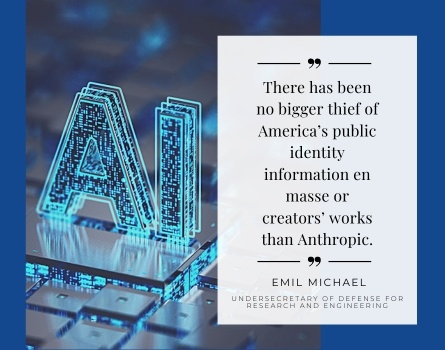
On February 27, Undersecretary of Defense for Research and Engineering Emil Michael took to X to voice his frustration with Anthropic due to disagreements between the US military and the AI company over government use of its technology. In the since deleted post, Michael accuses Anthropic of attempting to prevent government employees from accessing public databases and claims that Anthropic CEO Dario Amodei is trying to “make new law.” Notably, Michael wrote that the situation is ironic because “there has been no bigger thief of America’s public identity information en masse or creators’ works than Anthropic.”
While the post mostly focused on what seems to be at heart a contract dispute, it’s worth the attention of the creative community because it’s yet another recent example of the Trump Administration’s recognition of the copyright implications surrounding generative AI training and the culpability of leading AI companies. Earlier the same week, in response to efforts in Florida to regulate AI at the state level, the White House reinforced the positions laid out in its Executive Order on AI from December 2025 that, among other things, says AI policies should ensure that “copyrights are respected.”
Michael’s recognition of Anthropic’s blatant theft and the liability it faces is especially notable given his background in tech. Before joining the Trump Administration, Michael was senior vice president of business and chief business officer at Uber and CEO of the social media analytic company Klout. He’s certainly no stranger to Silicon Valley and tech culture, and he seems aware of the ways that some companies have flouted copyright law as they’ve built and commercialized generative AI technologies. Indeed, while Anthropic was the target of Michael’s post, there are many other AI companies that have engaged in the same illicit activities—stealing from human creators to develop incredibly lucrative AI models.
Importantly, after calling out Anthropic theft of creators’ works, Michael’s post says “search for the lawsuits.” This is no doubt in reference to the multiple copyright infringement lawsuits Anthropic is facing related not only to its unauthorized use of copyrighted works for training but also for the way the company downloaded massive amounts of pirated works. Courts have already found Anthropic liable for such obvious infringement, leading to a groundbreaking settlement with authors, and many other leading AI companies face similar claims.
While only so much can be read from a deleted X post, the underlying sentiment, reinforced by Executive Orders, speaks volumes about this Administration’s recognition of the value of copyrighted works and the way some AI companies are violating established copyright laws. (And as an aside, one can’t help but laugh at the idea of gen AI execs and their VC overlords squirming at the optics of a high ranking military official undercutting their breathless assertions that but for mass copyright infringement America’s national security is at risk.”)
It wouldn’t be surprising if Undersecretary Michael’s frustration reflects a broader discomfort with AI overreach and absolutism within the executive branch. Indeed, despite the tech industry’s all-out lobbying effort to stay close to the Administration and its ties to seniormost policymakers, it has not been able to overcome the strong US policy commitment to protecting ordinary Americans, as best reflected in the Senate’s 99-1 vote against a proposed ban on state regulation of AI.
It should be clear to these companies that their brazen theft of creators’ works has not gone unnoticed by the Administration, and self-serving claims about needing to use whatever material they like to train their models are likely falling on deaf ears.
If you aren’t already a member of the Copyright Alliance, you can join today by completing our Individual Creator Members membership form! Members gain access to monthly newsletters, educational webinars, and so much more — all for free!