

Creator Spotlight with Composer and Author Marsha Schweitzer
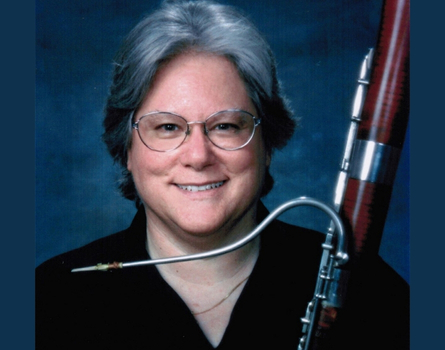
This week, we’re pleased to introduce bassoonist, arranger, composer, and author Marsha Schweitzer. Marsha retired after 45 years as Associate Principal Bassoon of the Honolulu/Hawaii Symphony and after 50 years as bassoonist of the Spring Wind Quintet. She is the author of The Arts from the Bottom Up and a current member of both the Copyright Alliance and the Authors Guild.
What was the inspiration behind becoming a creator? What do you enjoy most about the creative process?
Necessity is the mother of invention. I was the bassoonist of the Spring Wind Quintet, a professional wind quintet in Honolulu, Hawaii. The repertoire for the wind quintet is rather small, as it includes very few works by major composers and almost nothing that crosses over genres or qualifies as “party music.” I became an arranger to rectify that situation. In my 50 years with the quintet, I produced over 100 arrangements for chamber ensembles, ranging from transcriptions of major orchestral and piano works to pop songs, show tunes, church music, wedding and holiday music, jazz, and Hawaiian music.
As an arranger, I most enjoy dressing up great works in new clothes, sometimes just transcribing the work, changing the instrumentation, and other times adding new creative elements. The most fun comes in my more imaginative arrangements when I feel the Muses at work, bring a new countermelody, harmonic progression, or rhythmic pattern to mind. The music comes not from me, but through me.
Can you talk through your creative process? How long does it take? Does everything you produce make money?
Arranging is a little quicker than composing; having the original work as a basis gives me a head start. I begin with an original score, lead sheet, or piano/vocal score and add harmonies, countermelodies, rhythms, and sometimes introductions, codas, or bridges. The varied instrumentation of chamber ensembles provides a rich color palette, which gives my imagination a wide playing field. Depending on the complexity of my raw material, an arrangement can take as little as an hour to complete, or as much as six months.
Classical chamber music is a very small niche, and almost nothing makes money – not because of lack of interest or demand, but because of piracy, file sharing, and now AI.
Have you experienced copyright infringement, and if so, how has it affected you personally and financially?
Two of my very popular Christmas arrangements were pirated by a very large Canadian music company. I was deeply affected personally by the sense of violation and further by their refusal to respond to my lawyer’s cease and desist letter. I had to give up the fight because I am just a small-time creator/publisher without the resources to fight a court battle with a large company, complicated by the fact that they are a Canadian company and the battle would have to be fought in an international court. I can’t say how much money I lost due to this piracy, but their Christmas albums are very popular globally, so I believe my lost royalties are considerable.
What do you do when you encounter someone stealing something you’ve invested your intellect, time, and money into?
I get my lawyer involved in appealing to the infringer to pay royalties owed, or failing that, I get the platforms who are selling or streaming stolen music to take the offending music off their sites. Sometimes they take the music down, but often it quietly reappears a little while later. The system is failing us miserably.
What is the best piece of advice that you would give other creators in your field about copyright and how to protect themselves?
By all means, register your copyrights so that you have documentation to take to court if necessary. But the reality is that it’s difficult for small publishers and creators in small markets to protect their works. Unless you are a famous headliner or employed for hire by a producer who takes the risk and pays you no matter what, the only way to avoid disaster is to refuse to allow recordings/reproductions or other derivative works, and keep your work off the internet. Not a viable strategy in the 21st century.
How has AI technology impacted your works and career?
The music industry has suffered from precursors to AI ever since sound recordings were invented.* We took another hit when analog went digital, and again when digitization and sampling allowed computers to replace not only composers but also live performers. The current developments in AI are just the next step along the same path. My career is almost over, so today’s AI is not a huge factor for me. Young artists will have a much more difficult time.
* Although the phonograph and motion picture camera were invented at roughly the same time, around 1880, motion pictures were protected in the copyright law (1912) SIXTY years before sound recordings (1972).
If you aren’t already a member of the Copyright Alliance, you can join today by completing our Individual Creator Members membership form! Members gain access to monthly newsletters, educational webinars, and so much more — all for free!