

Creator Spotlight with Designer and Author Earnest Diaz D.F.A.
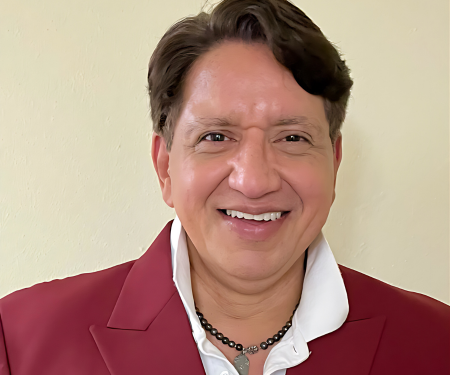
This week, we’re pleased to introduce designer, author, composer, and filmmaker Earnest Diaz. Earnest has an award-winning book and screenplay and has earned over 300 global honors. He also has a permanent collection in the Oz Museum. After reading his spotlight, follow him on Twitter/X and Instagram, and visit his website.
What was the inspiration behind becoming a creator?
A mimosa tree in our front yard, a sewing machine, and The Wizard of Oz inspired me to become a creator. At the age of five, I was playing with two cousins when I lost my grip while hanging from a branch of a mimosa tree. I fell and struck a tree root, suffering an injury that left me recovering at home for several weeks. During that time, my attention shifted from recovery and schoolwork to watching my mother sew. Fascinated by the process of making two pieces of fabric stick together, I began teaching myself the basics of sewing.
While I was recovering, The Wizard of Oz was showing at a local theater. Mother decided to take me to go see it, to get my mind off of recovery. She said I was screaming at the witch and crying because the witch was taking Toto away from Dorothy. As I learned to cope with a slightly disfigured face from the accident, I found myself drawn to the Cowardly Lion. His journey from fear to courage resonated deeply with me and revealed the transformative power of storytelling and creativity.
Looking back, those three influences—the mimosa tree, my mother’s sewing machine, and the Cowardly Lion—set me on the path to becoming a creator. What began with sewing evolved into designing for brides, grooms, casual / business wear, costumes, film, stage, music videos, and reality television. It also led to authoring the award-winning coffee table book Thankful and writing its screenplay adaptation, which has received more than 300 awards at film festivals around the world. My creative journey later expanded into visual art, with the “Thankful Series” and exhibitions in Switzerland, Germany, UAE, and France, including an exhibition at the Carrousel du Louvre in Paris during the 2025 jewelry heist. And now, a seven-time recipient of an Honorary Doctorate of Fine Arts.
It all began with a childhood accident, but the lesson I carried forward was one of courage—the courage to create, transform, and tell meaningful stories.
What do you enjoy most about the creative process?
What I enjoy most about the creative process is the freedom to brainstorm and explore different possibilities before narrowing in on a final direction.
With fashion design, I enjoy balancing creativity, comfort, artistry, and functionality to create something that is both expressive and wearable. With storytelling, I love developing characters that bring the story to life. Sometimes they are larger than life, and other times they are so realistic that audiences see a part of themselves in them.
With music, the creative process can be heavy or light. Sensual or playful, the range of creativity in music is infinite. A simple 1- 2 beat can change the entire dynamic of the song.
No matter the creative medium, I challenge myself to explore complete freedom of expression before the editing process begins. Throughout my journey, and through the recognition my work has received at various film festivals, I have learned that creativity often requires determination—the courage to explore new ideas, take risks, and remain open to unexpected discoveries.
Can you talk through your creative process? How long does it take? Does everything you produce make money?
The creative process varies by project.
Clothing design: I can nail a concept with a first sketch or over a few days to a week, then the process moves into pattern making, cutting, and sewing. With fittings and adjustments, a single garment typically takes six weeks to a year—longer for custom fabrics or more complex couture pieces.
Writing: Ideas often arrive as a flash—a rhyme, lyric, rhythm, or character—and I have to capture them immediately, either by writing them down or recording them. Design ideas tend to linger; written pieces need to be captured in the moment when inspiration strikes.
Timing examples: I once wrote a short children’s story in about three hours (it’s now in video development stage). Another project, Unity: New Traditions for LGBT Nuptials, has evolved over decades — roughly 33 years of development and refinement.
Does everything make money? Yes and No. Some projects do, but many are labors of love. For example, I spent 622 hours hand-sewing the King of the Forest AstroTurf cape trimmed with white flowers as a tribute to Bert Lahr’s Cowardly Lion from the Wizard of Oz for the cover photoshoot for Fashion Art Media magazine out of Scotland. I then donated that cape to the Oz Museum in Wamego, Kansas, where it now has a forever home.
What do you think is the biggest misconception about your line of work?
The biggest misconception is that my work is easy or just “sketch and send to a manufacturer.” It isn’t. I juggle multiple projects at once—sewing, pattern making, writing various stories, composing lyrics—and often switch between tasks throughout the day. That rhythm of jumping between creative modes is part of my process, and it leads to long workdays (sometimes 17–19 hours).
For a fashion show; when it is required, I, myself will build a pattern and prototype, then provide the manufacturer with the pattern, prototype, and a detailed spec sheet. When not using a manufacturer I tend to build everything. The reality is that a lot of unseen, intensive work goes into each piece and project.
When did you first become aware of copyright, and why?
I first became aware of copyright when a close friend saw my designs and suggested I make copies and mail the originals to myself — what people called a “poor man’s copyright.” I was 19 and knew only design. The first pieces I mailed were a full handbag collection that I cold-sent to a major handbag company to see if I had what it took to be a designer. They used a few designs; it showed me my ideas were marketable and taught me to properly protect my work. Of course, I now know that a “poor man’s copyright” is not a legally recognized substitute for registering your works with the U.S. Copyright Office.
How has AI technology impacted your works and career?
AI has been a useful tool, mostly for editing and speeding up routine tasks. When I wrote lyrics early in my career, I wrote everything by hand first and then onto a laptop; AI didn’t exist then. I have copyrighted music I composed before AI, and my first major release, “Let Them Eat Cake,” which are an instrumental song and music video with a heavy sports theme. They have done well, the music I have out now I composed and created before AI existed.
Lately I’ve experimented with AI for music production—it can generate production results much faster than traditional recording, layering, studio time, rehearsals, and scheduling. Still, I don’t rely on AI to create complete pieces. I begin by jotting lyrics and sometimes rhythms on paper or in my phone’s notes app. Or I will pull out the drumsticks and record a rhythm I hear in my mind.
With writing, I use AI mainly for light editing such as punctuation, spelling, and polishing text. I can say I have never used AI to create a full story.
Designing is whole different ball park. After 30+ years as a designer, my process is and always will be analogue: ideas come in dreams or from shapes I notice, and I sketch everything by hand on a paper, a napkin or in a sketchbook. I avoid designing on connected devices because I don’t want my work exposed to potential hacking.
If you aren’t already a member of the Copyright Alliance, you can join today by completing our Individual Creator Members membership form! Members gain access to monthly newsletters, educational webinars, and so much more — all for free!